Friday, January 12, 2018

Making a Difference

You can make a difference when it comes to human impact on our environment. I encourage you to take a moment to read this and give it serious consideration.

Even if you care about the environment, it isn't always clear how you can make a difference. What you eat can make a difference.

This is a short segment (15 min) of the longer video, Cowspiracy.
https://youtu.be/dSjE8xw_-Dg

To me, it sounds a bit dire and alarmist and I get tired of alarmist videos. However, I believe most of the data is valid.

Even if you don't believe that human activity/animal agriculture is the major driving force for climate change, I think it is pretty easy to connect both to air/water/soil pollution, natural habitat destruction, species extinction and depletion of resources. You can see some of this for yourself if you notice your surroundings.

I find it depressing to drive/bike from Goshen to Indianapolis because of the vast regions devoid of forests, natural ditches and other natural habitats. So much has been removed to make room for corn and soybean production. Most of these crops go to animal consumption.

If you make a long drive, here in Indiana or anywhere, make note of the distance a pollinator/wild animal must travel to find blooms/food/shelter. Notice how much of the land is still natural.

If you are skeptical of this documentary, I encourage you to spend a few moments researching how much water and land is required for some of the foods you eat, especially if you eat meat.

I would contend that we also need to reduce all pollution when possible. For example, when I bike to work, I certainly smell the results of burning petroleum coming from parked or passing vehicles or release of pollution from factories. These sources of pollution are very noticeable, but it is typically less obvious how our food choices can make a difference.

It is extremely tough to consider how we can change our behavior and make different choices. Our first instinct is to dismiss or ridicule, often because it feels like we are "attacked". I know there are many changes I still need to make to reduce my impact on the environment.

I encourage you to consider what you can do. Talk about it and seek ideas with others. Even just one step forward is progress.

Sunday, September 13, 2015

CMC Bike Ride

The Creation Care Class is sponsoring a bike ride for College Mennonite Church members.

Go here to sign up.  You may need to scroll down to check the "Sign Up" box before you click the "Submit and Sign Up" button.  http://www.signupgenius.com/go/20f0449adab22abfb6-cmcbike

When: Sunday, September 13, 2015, 1:30pm.  We'll leave no later than 2 pm. We estimate that a leisurely rider will take 45-60 minutes to bike to Ox Bow. After the nature talk we'll bike back to CMC.

Why: Human and environmental fellowship
  • We'll have a short environmental presentation at Ox Bow park.
    Where: CMC parking to Ox Bow Park (7.5 miles one way)

    Here's a map, from CMC to Ox Bow Park.  We'll get on the bike trail just east of the railroad crossing at 8th and Lincoln Ave.

    Tips:
    • If you have rarely or never ridden bike more than 5 miles without stopping, we recommend you go on a 5 mile bike ride before Sept 13.  It is good to get out and make sure everything is in good working order.
    • Make sure your tires are pumped up, your brakes and gears work, and your seat is comfortable.  Local bike shops can help repair your bike and make sure it is adjusted to fit you.
    • You will want water.  Invest in a big bike water bottle and water bottle cage if you have none.
    • You may want to bring along a snack.  You can find Clif bars, PowerBars, etc. at the grocery.
    • Wear a good fitting helmet.  They are much cheaper than a trip to the emergency room.
    • Wear athletic and/or biking clothing.  Regular clothes get uncomfortable very quickly.
    • Know your physical limits.  You can turn around to return home at any point.

    --------
    Great ride, beautiful weather, tasty treats and an intriguing wild edibles walk with Paul Steury.


    Wednesday, July 22, 2015

    Zero Waste Home

    Just when you think that you are doing pretty well with recycling and reusing things, someone like Bea Johnson comes along and show you that you have barely scratched the surface of not being wasteful.

    The video of her shopping on YouTube -- Zero Waste Home -- is inspiring and depressing at the same time. It's inspiring to see how creative she is in cutting down on waste, but at the same time, I don't see how it is very practical for most of us. But it does give you ideas.

    One thing I tried was to take cloth bags to the grocery store for bagging produce instead of store plastic. I have been taking cloth bags for groceries for many years, but I've been bagging the produce in those plastic, tear-off bags scattered around the produce section. I took two cloth bags: I put the produce in one as I shopped, and when I got to the self check out, I put the second bag on the checkout-sensitive area (telling the register that I was using my own bags), and as I processed the produce out of the first bag, I put it into the second one. It felt like a small step in reducing plastic waste.

    Sunday, May 3, 2015

    May's Task: Wash clothes in cold water; air dry your laundry in summer

    Tips for doing without a dryer:

    • Install a clothesline.
    • Plan to do laundry on sunny, breezy days whenever possible.  Wash and hang clothes in the morning. 
    • Using the dryer for just a few minutes can help  “fluff them up”  so they dry without wrinkles.  This is especially helpful with front-loader washers, which spin so fast that clothing is often pressed tightly together.
    • Hang shirts on plastic hangers to dry.  The hangers can be hung on your clothesline outside, on a shower bar, or on a closet rod installed in your laundry room.
    • Use folding racks to dry things indoors.  These are especially useful in winter, but can be used any time of year.
    • A retractable clothesline installed in the basement adds drying space when needed, but is easily moved out of sight when not in use.
    • Clothes last longer when not subjected to dryer heat.
    • If your laundry smells of mildew, it is probably not drying fast enough.  Hang it as soon as the wash cycle is done, and make sure there is sufficient air circulation around each item.  Also try adding a small amount of vinegar to the rinse cycle.
    • Some home owners’ associations have rules against outdoor clotheslines.  However, in many places these rules are not enforced.

    Sunday, December 7, 2014

    Alternative Gift Giving Ideas

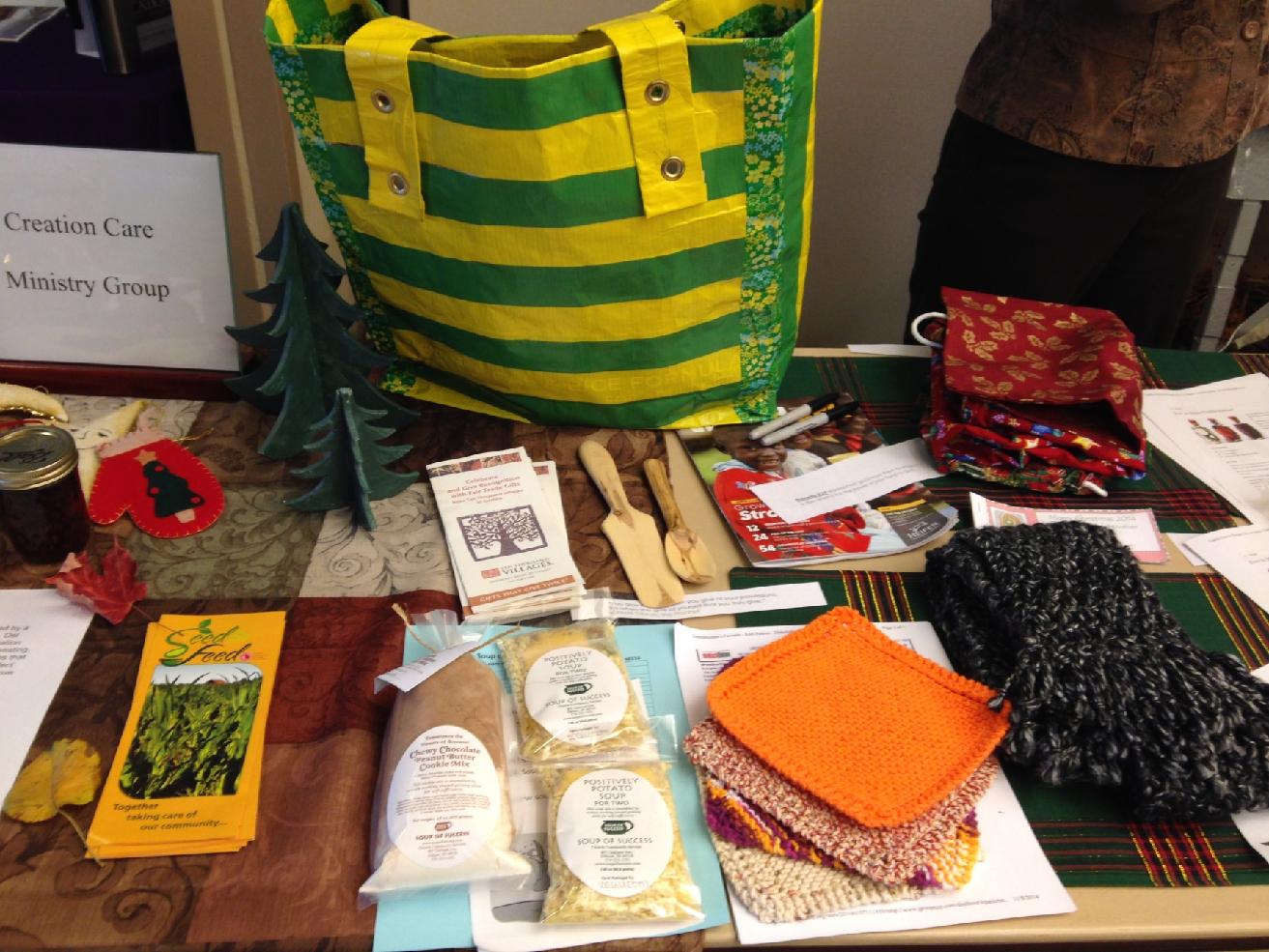
    Creation Care Advocates put their heads together to fashion a list of alternate gift giving ideas.  If you missed the November class session or our booth at Mission Fest, the ideas are listed below.


    Mennonite Central Committee (MCC) http://mcc.org/christmas-giving or https://donate.mcc.org/
    Mennonite Economic Development Associates (MEDA) http://www.meda.org/ways-to-give/gift-solutions-catalogue
    • Home roasted nuts – you can do this on your grill.  This goes better with a cage to turn the nuts as they roast.
    • Homemade peanut butter
    • Prayer flags
    • Luminaries made by tracing photographs on paper attached to a jar with a tea light inside
    • Gift of kindness – money given to be used to help out someone else
    • Baskets available at the Farmer’s Market
    • Homemade tea box
    • Homemade wooden Christmas tree ornaments
    • Homemade bags for wrapping gifts
    • Soap making
    • Scarves made from old t-shirts
    • Make homemade vanilla extract
    • Make chai spiced honey from Kathy’s recipe
    • Make pies or other food items to give as gifts
    • Gifts of time such as folding laundry, cleaning, babysitting, leaf raking
    • Gifts that kids can make:  homemade coffee mug, rag doll made from discarded t-shirts and socks, bug catcher
    • Collect and give wild hazelnuts or black walnuts
    • Dad’s Wild Jelly available at the Farmer’s Market (Note:  we sampled the “Serviceberry” flavor made from local June berries with Tim’s homemade peanut butter on Rachel’s bread–delicious!)
    • Smucker’s maple syrup (made by George and Barbara Smucker)
    • Small calendars made from a sheet of 8.5x11 paper cut in 12 sections and hand lettered
    • Jellies made from Washington state blackberries
    • Homemade applesauce

    Sunday, September 7, 2014

    Climate March - coming to Goshen soon

    A group is walking through Goshen on their way from LA to DC to raise awareness about caring for our creation.

    Here's a message from Glenn Gilbert

    I was just made aware of a group of people walking from Los Angeles to Washington DC to raise awareness for climate action.  There is a link to their site here http://climatemarch.org/

    They are currently leaving Iowa and entering into Illinois.  The plan is to be in Goshen September 15th and I have agreed to organize a place for them to stay while they are here and a program to introduce them to our community and what we are doing to promote climate action and sustainability.  They are also interested in presenting themselves and what they are doing.

    I am hopeful to engage the student group ecopax, but not yet certain how well that will happen.  Would you be interested in seeing if there would be CMC people that would be interested in being part of making all this happen. I'm anticipating about 30 walkers. It would also be a good chance for your group to interact with our GC students.  

    While they are prepared to camp (somewhere yet to be determined) on campus, some of them do appreciate a bed to sleep on, so I would be looking for homes in the neighborhood, or perhaps the church basement if cots are available.  And if it is stormy, they might all like a place to stay inside.  

    If there is enough interest, a potluck supper might be an option.  I will be glad to fill you in with more information, if you are interested or available.  Perhaps there are others in your sustainability group that might be interested in helping.

    Thanks for considering this.-- 
    Glenn Gilbert
    Utilities Manager/Sustainability Coordinator
    Goshen College

    Sunday, August 3, 2014

    Hope

    We talked about how we hadn't seen butterflies this year, at least not many.  We let some milkweed grow around our shed and hoped.

    It finally happened.


    Thursday, July 24, 2014

    You are one...one difference.

    Each of us is one.  Not "just" one, but one.  One, as in our existence makes a difference.  Together we may be mighty, but even so, one makes a difference.

    Many of us forget this.

    Many also forget that we are meant to participate in and with the humans, animals, plants, water, air and ground around us...with respect.  The earth is one.  We can fool ourselves into thinking that we can be the masters, but the rules of nature were formed long before us and will endure long after.

    We are one - video

    Friday, June 20, 2014

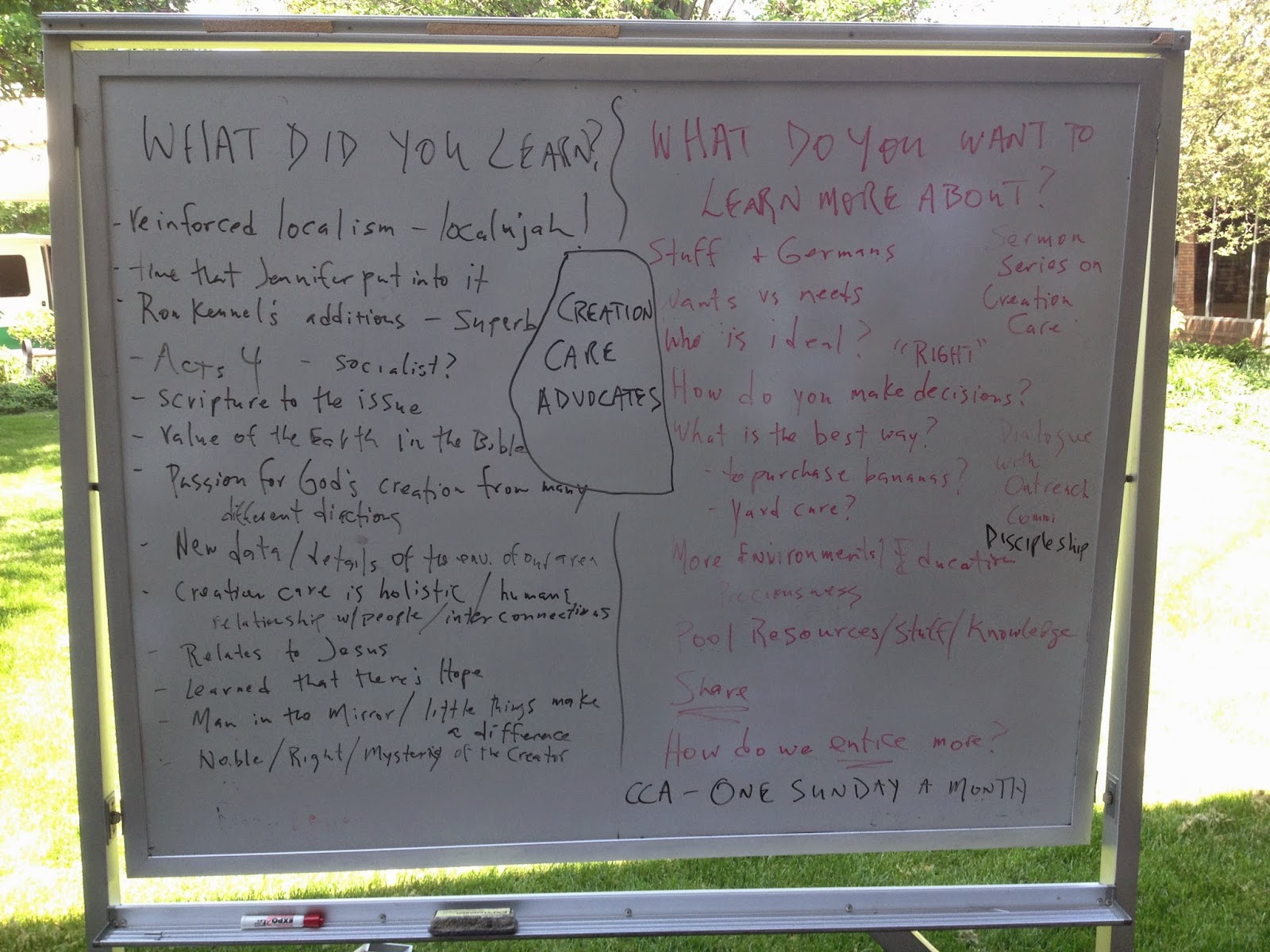
    What did we learn? What do we want to learn more about? What do we want to act upon?

    On the final Sunday of this pilot curriculum we brainstormed together what we learned from this creation care Sunday School Class, what we want to learn more about and what do we want to act upon!

    Sunday, May 18, 2014

    Accountable Communities

    This topic is quite challenging.  Our desire for independence is strong.  Here are some of the topics we covered today.

    Sunday, May 11, 2014

    Productive Guilt

    In today's leadership guide for session 10 exists this questions about living a simple lifestyle.
    • How can we discuss lifestyle issues in ways that inspire change rather than unproductive guilt?
    Commonly shared is the influence of guilt and fear on our lives. It can nudge us to make changes for the better or can shut down dialogue and action. Guilt is closely associated with shame and shame is not an elegant feeling.  It takes a great deal of courage to share openly when shame is involved.

    Fear is terribly effective at changing behavior, stopping conversation and diverting all energies since it triggers our built-in flight or fight response.

    How does guilt and fear relate to simple living?  Try sharing your ideas for how to live simply or sustainably and you'll quickly see. The natural response is to defend and rationalize current practices, invalidate the idea through criticism or minimize the importance of the idea.

    What steps can you take, small as you think it might be, to live more simply?  What ideas do you think you could implement, in the next hour? 

    If someone shares an idea with you, check your first reaction or instinct. Are you allowing the person to share without criticism? Do you feel defensive, perhaps indignant or even a hint of shame?

    Learning how to discuss simple living is almost as important, and difficult, as finding ways to live simply. Give yourself the grace to try simpler ways so you can do the same for others.


    Sunday, May 4, 2014

    Simple Living

    This week's session is on choosing a simple lifestyle.

    Ironically, we tend to complicate this topic.  When we start to consider what simple living means, looking inward first tends to be rather disturbing.  We realize how each choice we make is so easily influenced by everything that isn't God-centered.

    Taking small steps in the right direction is how any epic journey begins.  So..

    1. When you buy
      1. How will you share it with others?
      2. What do you really need? Can you borrow it or lend it?
      3. What does it really cost? Carbon footprint, relationships, time to maintain, storage space, and...oh right financially
      4. How long will it last?
    2. When you use
      1. What is the shortest duration you can use it?
      2. Do you really need to use it?
    Here's an interesting video on getting stuff
    Story of stuff

    TASK
    Try the voluntary Fuel Tax group idea.  Assume you have had to pay $10 per gallon of gas.  Save the difference you actually pay.  Put it in a jar and at the end of the month, quarter or year donate the money to an organization like the Farmer's Market or Maple City Coop who work towards sustainable, local foods.

    Tuesday, April 8, 2014

    Food Waste Links

    Wow.  This will make you think about how not to waste food.

    Tristram Stuart's  TedTalk "The global food waste scandal"

    Monday, April 7, 2014

    Carbon Footprint


    How would you respond if we could see carbon dioxide?  Here's a great illustration.

    Here are some other visuals regarding carbon footprints.

    Calculate your carbon footprint.

    Web page on CollegeMennonite.org

    We now have a page on collegemennonite.org!  Go here to view the curriculum that we will cover.
    We can continue to use this blog for reflection and comment on our topics.

    http://collegemennonite.org/index.php/discipleship/adult-sunday-school/creationcare

    Sunday, March 9, 2014

    Week 3 - Biblical Views of Nature (in Sojourners' classroom)

    Here's the document that goes with this lesson.  Week 3 Participant Document

    Lesson Goals/Hopes

    • Participants will examine their attitudes toward nature and compare and contrast them with the ideas presented in the essay.
    • Participants will broaden their understanding of community to include the community of creation.
    • Participants will learn from each other about parts of the natural world that class members value. They will identify actions that could help sustain these aspects of nature.
    • Participants will be inspired to work on the spiritual practices or household practices suggested. 

    Ecological Lens Questions (weekly questions)

    Each week we will review these questions as a way to help us focus on our relationships and interconnectedness.

    Ecological Lens Questions

    A. Where are we? 
    • How does our location in time & space affect our hearing of the text? 
    • What might the original writer have seen out the window and how does that differ from our view? 
    • How might the text speak in light of current environmental issues?
    B. Noticing non­-human elements: 
    • Name the species or ecosystems mentioned or implied in the text. 
    • Are we overemphasizing the importance of humans in this text at the expense of the rest of creation? 
    • How can we hear the unique presence, value and spiritual significance of nonhuman entities in scripture?
    C. Including creation in our community 
    • What interconnections are evident between humans, land and other living things? 
    • Can we articulate the interests of nonhuman beings in the text? 
    • Can we empathize with a river or a bird? If they could speak, what might they say to us? 
    D. How is God at work through creation? 
    • How is creation involved in God’s redemptive work? 
    • Can we see God at work in creation’s ability to generate life, provide for its inhabitants and heal itself? 
    • Have we over‐emphasized God’s redemption in human history at the expense of recognizing God’s sustaining presence in nature? 
    E. Connecting with Christ:
    • How is Christ involved in creation? 
    • In the restoration of creation? 

    F. Human justice and ecological justice 
    • Does this passage show a connection between injustice to humans and damage to the Earth? 
    • Does it offer guidance in caring for the most vulnerable people? 

    These questions are adapted from The Season of Creation: A Preaching Commentary, by Norman C. Habel, David Rhoads and H. Paul Santmire.


    Sunday, March 2, 2014

    CMC Pilots Creation Care Curriculum - Starting Today March 2


    1. Don’t Be Afraid
    Scripture: Matthew 1

    This session introduces an ecological lens (hermeneutical method) for reading the Bible in ways that illuminate the three-way relationship between humans, the earth and God.

    Here are some questions we may discuss.

    What towns, rural areas and bodies of water are within a five-mile radius of your congregation? A 25-mile radius?

    What urban areas do your members draw upon for goods and services? What rural areas provide for urban areas?

    Which parts of these circles do you visit frequently? Which parts do you ignore, or know little about?

    Tuesday, February 11, 2014

    HOT PIPES!


    February's Task: Insulate your hot water pipes

    Most water pipes in homes are uninsulated, which results in lost heat and causes the water heater to work harder, thereby increasing energy costs. If you have pipes which are warm to the touch, which “sweat,” or go through unheated areas, the fix is simple and very inexpensive.
    - From http://eartheasy.com/live_cheapheat.htm

    How to insulate water pipes
    (From http://eartheasy.com/live_cheapheat.htm):

    • There are various materials for insulating pipes, but the easiest to use is pre-slit foam pipe insulation. It is available at most hardware stores and usually comes in 3’ lengths. Look for the size that fits the diameter of your pipes, and choose the one with the highest R-value.

    • Simply snap the insulation over the pipe and run a strip of duct tape over the seam where pieces butt together. Join the split so it is facing downward on horizontal runs, and tape the long seam as well. Cut short lengths of the foam insulation with a razor knife. For corners, cut the insulation at 45 degree angles and wrap with duct tape.

    • Do not wrap too tightly as it will lose some of its insulation value. Any part of the insulation that is outside should be painted.

    • While you’re at it, insulate the cold water pipes too – this will help keep them from freezing in unheated areas or during cold weather if you’re away from home. (In areas of sustained freezing temperatures, the pipes will ultimately freeze; the insulation will only slow the process. The only way to prevent freezing is to drain the water or add heat (i.e. heat tape).

    For more information on insulating water pipes, see these sites:

    • a short video demonstrating application of different kinds of insulation

    • a site featuring links to other helpful water-saving information